
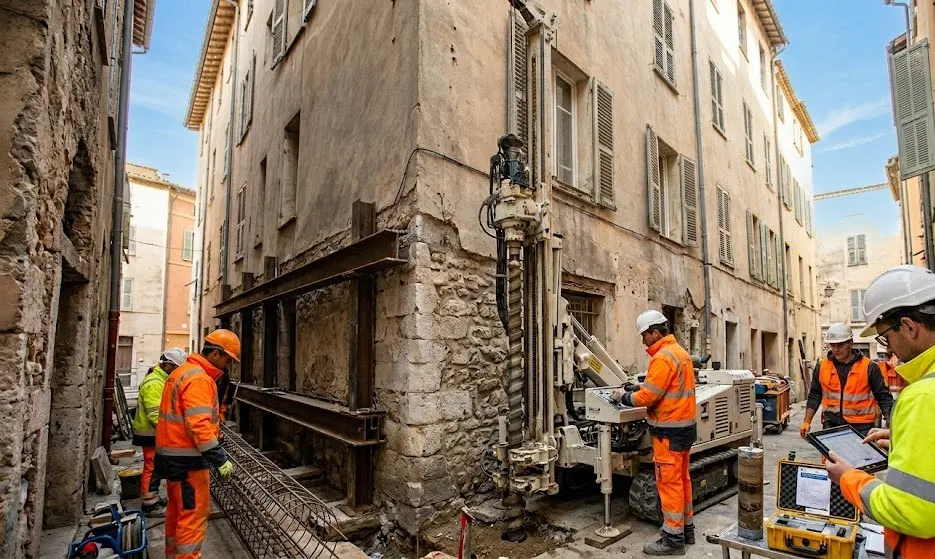
Underpinning — strengthening the foundations of an existing building
Underpinning with micropiles: cracked houses, settlement, drought damage on clay soils.
Underpinning transfers the loads of an existing building to stable, deeper ground when its foundations are no longer adequate: cracks opening up, settlement, clay weakened by drought. We work on houses, apartment buildings and older structures, alongside engineering firms and insurers’ loss adjusters.
Giving a moving building sound footings again
What is underpinning?
Underpinning strengthens or deepens the foundations of a building without demolishing it. It is needed when cracks open and close with the seasons, when a corner of the house sinks, or when an extra storey would load foundations that were not designed for it.
In the Var and parts of the Alpes-Maritimes, the most frequent cause is shrink-swell clay: the ground shrinks in summer, swells in winter, and shallow foundations follow its movements. Poorly compacted fill, leaking pipes and sloping ground come next. Underpinning then means carrying the building on micropiles anchored below the moving zone, connected to the walls by reinforced concrete pads or ground beams.
Signs of a foundation problem
They call for a diagnosis before any crack repair.
Stepped or diagonal cracks
Along the joints of a block wall, or running from the corners of doors and windows.
Cracks that change with the seasons
Wider at the end of summer, finer in winter: a sign of clay soil.
Sticking doors and windows
Openings distort when part of the building sinks.
Terrace or extension pulling away
A gap opening between the house and a terrace, garage or conservatory.
Clay soil and drought
Municipality recognised as a drought natural disaster area, medium or high shrink-swell hazard.
Plans for an extra storey or extension
New loads on existing shallow foundations.
Our expertise
Know-how in special works
We carry out underpinning with micropiles on damaged buildings or buildings to be strengthened, working with the engineering firm and, after damage, with the insurer’s loss adjuster.
- Underpinning with micropiles
- Connection pads and ground beams
- Drilling indoors, under a conservatory or in a garage
- Drought damage and expert assessments
- Sites with difficult access
How a Sirianni Travaux project unfolds
Diagnosis
A geotechnical diagnosis (G5 mission, French standard NF P 94-500) establishes the cause of the damage: soil, foundations, water.
Design
Geotechnical design (G2 mission) and micropile layout based on the building’s load take-down.
Works
Micropiles drilled and grouted along the walls, outside and inside, then connection pads cast against the existing foundations.
Monitoring and repairs
Construction monitoring (G3 mission), a verification test, then crack repair once the structure is stable.
Frequently asked questions
When should underpinning be considered?
Do we have to move out during the works?
Can underpinning be covered by insurance?
Which technique is used?
How long do the works take?
Is the result lasting?
Related services
Micropiles
Drilled and grouted micropiles: underpinning, extensions and building on low-bearing ground.
ViewConcrete & masonry repair
Repair of damaged concrete and masonry: corroded reinforcement, cracks, joints, old walls.
ViewBerlin & micro-Berlin walls
Berlin and micro-Berlin walls: basements, car parks and excavations on property boundaries.
ViewLet’s talk about your project or structural issue
Describe the situation — cracks, settlement, a new build — and we will come back to you once we have analysed the structure and its surroundings.