
Ground retaining works — stabilising and securing structures
Retaining works: walls, nailed walls, Berlin walls and gabions, for sloping ground and unstable slopes.
A retaining structure holds back the ground where levels change: unstable slope, sloping plot, excavation, old wall that is tilting. The technique depends on the height to be retained, the soil, water and the space available.
Retaining ground according to height, soil and access
What are ground retaining works?
Two families of structures exist. Walls, in masonry, gabions or reinforced concrete, retain the ground by their weight or their footing; they are built in cut or fill and designed to French standard NF P 94-281. Embedded walls (Berlin walls, nailed walls or micropile walls) are installed in the ground before or during excavation; they fall under NF P 94-282, or NF P 94-270 for soil nailing.
In every case, water is the main enemy: most walls that tilt are poorly drained walls. Drains, weep holes and geotextiles are part of the structure. An existing wall that leans can often be stabilised by nailing or anchors rather than demolished.
Choosing the retaining technique
It is decided after the geotechnical study, according to the site.
Masonry or gabion wall
Gravity structure, for moderate heights, along roads, canals or the sea.
Reinforced concrete wall
Wall with a footing, when there is room to excavate behind it.
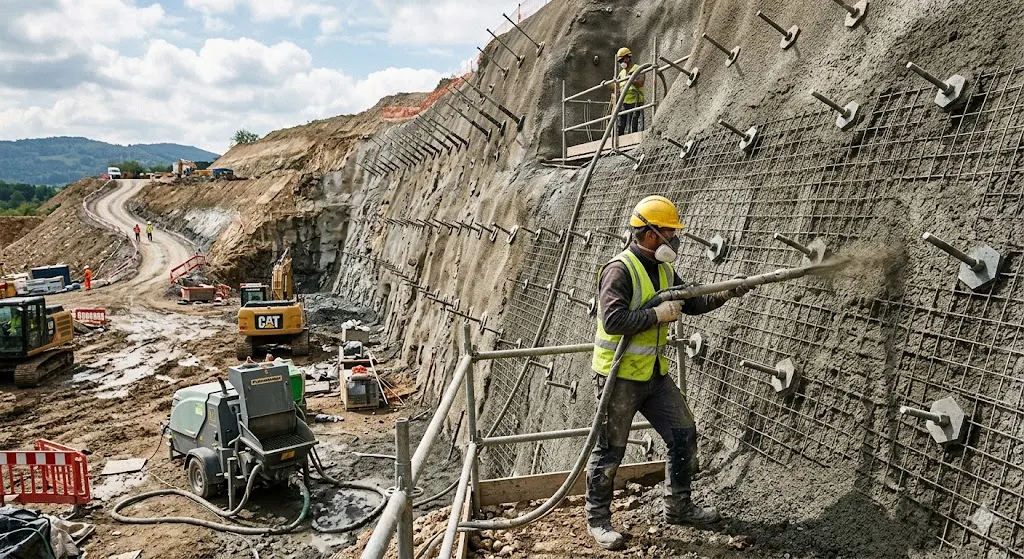
Nailed wall
Steep slope reinforced with nails and a shotcrete facing.
Berlin or micropile wall
Excavation against a neighbour or a road, with no footprint behind the wall.
Ground anchors
To hold back a high wall or stabilise an existing wall.
Drainage
Drains and weep holes: the condition for any retaining structure to last.
Our expertise
Know-how in special works
We build retaining structures in masonry, gabions, nailed walls and micropile walls, from the seafront to the hinterland, including where access is difficult.
- Ground retaining
- Nailed walls and shotcrete
- Micropiles and deep foundations
- Underpinning
- Difficult-access works
How a Sirianni Travaux project unfolds
Study
Geotechnical study: soil type, water, overall stability of the slope.
Choice of technique
Wall or embedded wall, according to height, available space and neighbouring structures.
Works
Built in phases, drainage included, keeping the ground stable at every stage.
Monitoring
Construction monitoring (G3 mission, French standard NF P 94-500) and movement checks.
Frequently asked questions
What is a retaining structure?
Retaining wall or nailed wall: which to choose?
Why does a retaining wall tilt?
Can a leaning wall be repaired?
Can retaining works be carried out in difficult access?
Are your retaining works covered by ten-year liability insurance?
Related services
Berlin & micro-Berlin walls
Berlin and micro-Berlin walls: basements, car parks and excavations on property boundaries.
ViewSoil nailing & nailed walls
Soil nailing and nailed walls: retaining slopes and excavations, stabilising existing walls.
ViewProtective mesh installation
Pinned mesh, draped mesh and rockfall nets: protection against falling rocks on slopes and cliffs.
ViewTell us about your site — we take care of the rest
Tell us about your site or the damage you have observed: our answer is always based on an analysis of the structure and its surroundings.