
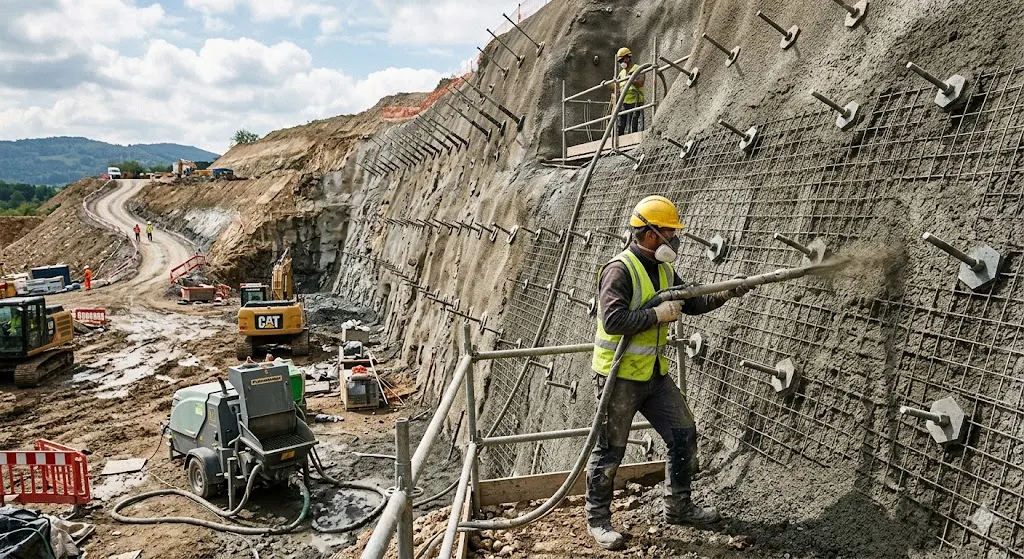
Ground anchors — anchoring and restraining structures
Drilled and grouted ground anchors: stabilising retaining walls, excavation walls and slopes.
A ground anchor ties a structure to stable ground at depth. It holds back a retaining wall that is tilting, anchors an excavation wall or a slope facing. We drill, grout and test our anchors across the Alpes-Maritimes and the Var, including where access is difficult.
Finding stability where it lies: at depth
What is a ground anchor?
A ground anchor is a steel tendon, bar or strands, bonded to the ground with cement grout and working in tension. It has three parts: the head, which transfers the load to the structure; the free length, which crosses the unstable zone; and the fixed length, bonded in competent ground. Its execution is governed by standard EN 1537.
An active anchor, tensioned on installation, prevents the structure from moving from the outset; a passive anchor only works when the structure moves, which is the principle of soil nailing. A temporary anchor serves for the duration of a project, two years at most; a permanent anchor receives corrosion protection designed for the service life of the structure.
Where ground anchors are used
Each anchor is designed for the thrust to be resisted and the anchoring ground.
Tilting retaining wall
Anchors drilled through the wall, heads connected by a steel waler that spreads the load.
Excavation wall
Soldier pile (Berlin) or micro-Berlin wall anchored as excavation proceeds, in urban sites.
Slopes and rock faces
Anchors combined with soil nailing, shotcrete or protective mesh.
Structures under thrust
Buried structure, abutment or slab to be held against earth or water pressure.
Tension tests
One or more anchors are loaded to check their capacity before acceptance.
Difficult access
Compact drilling rig, set up on a platform or from ropes.
Our expertise
Know-how in special works
We install ground anchors to stabilise existing structures, or alongside our retaining works: Berlin walls, soil nailing, shotcrete.
- Active and passive anchors
- Stabilisation of retaining walls
- Walers and load-spreading beams
- Tension verification tests
- Drilling in difficult access
How a Sirianni Travaux project unfolds
Survey of the structure and ground
Thrust to be resisted, anchoring ground and failure mode to prevent, based on the geotechnical study.
Design
Free and fixed lengths, working load, inclination, corrosion protection.
Drilling and grouting
Drilling, for example at 127 mm, placing the tendon and grouting; tensioning for an active anchor.
Testing and acceptance
Tension verification test and construction monitoring (G3 mission, French standard NF P 94-500).
Frequently asked questions
What is a ground anchor for?
What is the difference between an active and a passive anchor?
My retaining wall is leaning: can it be stabilised without demolition?
How are anchors checked?
How long does an anchor last?
Are ground anchors covered by ten-year liability insurance?
Related services
Soil nailing & nailed walls
Soil nailing and nailed walls: retaining slopes and excavations, stabilising existing walls.
ViewBerlin & micro-Berlin walls
Berlin and micro-Berlin walls: basements, car parks and excavations on property boundaries.
ViewShotcrete
Dry-mix or wet-mix shotcrete: nailed walls, rock faces, slopes and structural repair.
ViewWorried about a crack? A project to secure?
Describe the situation — cracks, settlement, a new build — and we will come back to you once we have analysed the structure and its surroundings.